

Carried by 7 nurseries
View Availability at NurseryData provided by the participants of the Consortium of California Herbaria
View additional distribution information on the Jepson eflora
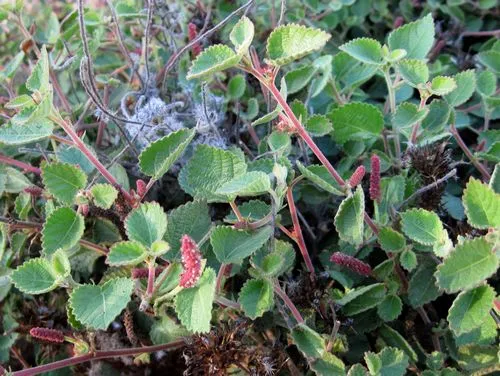
The flowering shrub Acalypha californica is known as the California copperleaf, and sometimes by the older name Pringle three-seeded mercury. It is the only Acalypha species native to California, where it is found from the Peninsular range foothills hills into the lower desert of San Diego County. It is a member of the chaparral plant community and most often grows in crumbling granite rocks, ledges and cliff faces, though it occasionally grows in sand washes. The plant bears beautiful light green serrated leaves with wavy hairy edges. Younger leaves tend to have pink or red edges. Older leaves turn pinkish or copper-colored in summer months. Stems are white, pink or red. Flowers appear as bumpy pinkish red spikes, sometimes with white speckles, growing out from the base of the leaf stems. It typically grows in a rounded mounding form. Beautiful plant but difficult to find in nurseries.
Shrub
2 - 3 ft Tall
5 ft Wide
Mounding
Slow
Evergreen
None

Pink, Red, White
Winter, Spring
Lawn alternative
Full Sun
Low, Very Low
Max 1x / month once established
Tolerates cold to 30° F
Fast
Typically decomposed granite or sand.
Soil PH: 6.0 - 8.0
For propagating by seed: No treatment. (Emery and Frey 1971).
15, 16, 18, 19, 20, 21, 22*, 23*, 24*
Near the coast it is often found in conjunction with oak woodlands. Inland it is found in desert transition chaparral near granite rocks, ledges and cliffs, and in sandy washes of desert canyons at the base of granite boulders as part of Creosote Bush Scrub or Alluvial Fan Scrub
Chaparral, Creosote Bush Scrub, Desert, Southern Oak Woodland
Chamise (Adenostema fasciculatum), California Buckwheat (Eriogonum fasciculatum), Chaparral Mallow (Malacothamnus fasciculatus), Brittlebush (Encelia spp.), Desert Agave (Agave deserti), Mojave Yucca (Yucca shidigera), Creosote (Larrea tridentata), Big Sagebrush (Artemisia tridentata), and cactus species
-
Likely
-
Confirmed
Diadasia rinconis