

Carried by 11 nurseries
View Availability at NurseryData provided by the participants of the Consortium of California Herbaria
View additional distribution information on the Jepson eflora
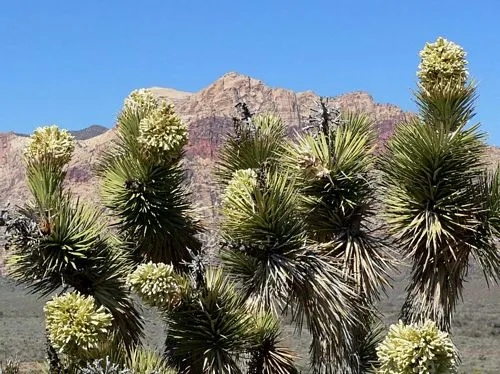
Joshua Tree is a native tree-like monocot that grows from southern California to Utah. Although it grows to tree size, it behaves like a Yucca in every other respect. It tends to grow in the high desert at elevations from 1600-6600 feet, though it grows up to 11,000 feet in the White and Inyo Mountains. It is exposed to lower winter temperatures than other parts of southern California. In locations where it is common, such as the Mojave Desert, it forms large colonies known as Joshua Tree Woodland. The leaves are stiff, long (6-9 inches), narrow and sharply pointed on the tips. The flowers are greenish-white held on a long panicle and pollinated by a moth. Around 25 species of birds use Joshua trees as nesting sites. Because of its slow growth rate and its very specific requirements, it is not often used in typical residential gardens. However, it could be a great choice for a larger garden in a desert or semi-desert area.
Shrub, Succulent
5 - 20 ft Tall
35 ft Wide
Rounded, Upright Columnar
Slow
Evergreen
Slight

White, Green
Spring
Hedge
Full Sun
Very Low
Max 1x / month once established
Moderate
Tolerates cold to -20° F
Fast
Requires fast draining, coarse grained alluvial soil.
Soil PH: 6.0 - 8.0
From seeds. For propagating by seed: No treatment.
Dry places, high deserts such as the Mojave Desert, Antelope Valley, and portions of Death Valley National Park
Joshua Tree Woodland
Clark Mounatain Agave (Agave utahensis), Burrobush (Ambrosia dumosa), Bigberry Manzanita (Arctostaphylos glauca), Big Sagebrush (Artemisia tridentata), Desert Marigold (Baileya multiradiata), Buckwheat (Eriogonum spp.), Apache Plume (Fallugia paradoxa), California Juniper (Juniperus californicus), Penstemon species, Bladderpod (Peritoma arborea), Apricot Mallow (Sphaeralcea ambigua), various cactus species
-
Likely
-
Confirmed
Anna's Hummingbird
Calypte anna
Angelic Sweat Bee
Agapostemon angelicus
Big-cheeked Mason Bee
Ashmeadiella bucconis
Great Purple Hairstreak
Atlides halesus