

Carried by 18 nurseries
View Availability at NurseryData provided by the participants of the Consortium of California Herbaria
View additional distribution information on the Jepson eflora
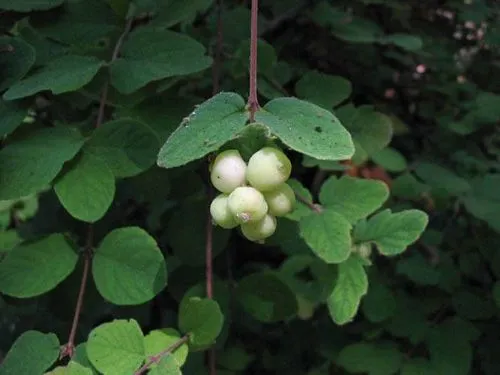
Symphoricarpos mollis, with the common names creeping snowberry, Southern California snowberry, and trip vine, is a shrub in the Honeysuckle Family (Caprifoliaceae). It is found in western North America from British Columbia to California inland to Nevada and Idaho.
The shrub does well in warm climates and can tolerate both intense sun and constant shade. It is a plant of chaparral ecosystems, especially along coastlines.
Shrub
1 - 2 ft Tall
3 - 4 ft Wide
Spreading
Winter Deciduous

Pink
Spring, Summer
Bank stabilization, Containers, Deer resistant, Groundcover, Lawn alternative
Partial Shade
Low
Max 1x / month once established, Never irrigate once established
Easy
Fast, Medium, Slow
Tolerates a variety of soils.
Can be cut back in winter
For propagating by seed: Soak in concentrated H 2 S04 1 hr. (or 3-4 mos. warm stratification) and 4-6 mos. cold stratification ( Emery and Frey 1971). Easily propagated from cuttings or divisions.
1, 2, 4*, 6*, 7*, 9, 14*, 15, 16, 17*, 18*, 19, 20, 21, 22, 23, 24
Dry open places; Yellow Pine Forest, Red Fir Forest, Lodgepole Forest, Mixed Evergreen Forest, Southern Oak Woodland, Chaparral
Lodgepole Forest, Red Fir Forest, Yellow Pine Forest
-
Likely
-
Confirmed
Orange-bellied Sweat Bee
Agapostemon melliventris
Texas Striped Sweat Bee
Agapostemon texanus
Golden-haired Miner Bee
Andrena auricoma
Buckell's Miner Bee
Andrena buckelli
Cucumbers
Cucumis sativus
Squash (Cucurbita)
Cucurbita
Buckwheat
Fagopyrum esculentum
Apples
Malus domestica