

Carried by 32 nurseries
View Availability at NurseryData provided by the participants of the Consortium of California Herbaria
View additional distribution information on the Jepson eflora
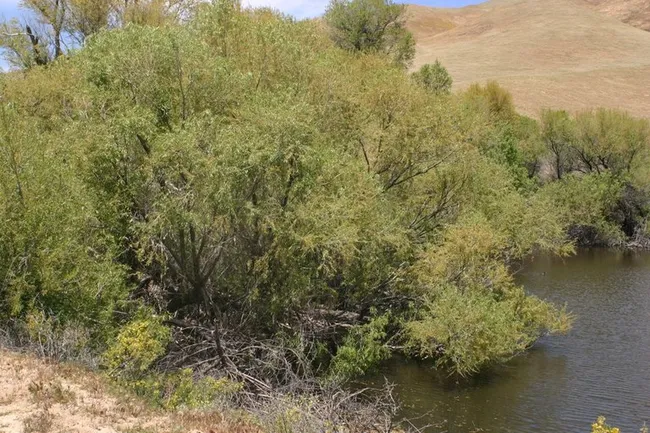
Arroyo Willow (Salix lasiolepis) is an abundant and widespread native small tree or shrub that grows in northern, southern and central California. Arroyo Willow likes water and in the garden must have constantly moist soil. It is a fast-growing small tree, reaching 15 to 30 feet high and 5 to 10 feet wide. The leaves are long and thin. Being deciduous, Arroyo Willow is leafless part of the year. The flower is a yellowish catkin that becomes a fluffy white mass of seeds.
Willows (Salix spp.) are very important wildlife plants, used by birds, insects, amphibians and mammals. Numerous insects, especially wasps, lay their eggs on willow leaves, forming galls. These galls are usually not harmful to the plant and should not be viewed as pests.
Arroyo Willow grows in full sun in a variety of soils, as long as it has adequate drainage. It is recommended as erosion control near streams. Spreading by root runners it can be invasive in moist areas. Gardeners with a bog or pond use it with other wetland plants such as Maple, Spicebush, Dogwood, Currant, and California Wildrose. It can be pruned or sheared in winter to form a hedge.
Tree, Shrub
7 - 35 ft Tall
15 ft Wide
Upright, Rounded, Upright Columnar
Fast, Moderate
Winter Deciduous

Cream, Yellow
Winter, Spring
Water features or wet habitats, Hedge
Full Sun
High
Keep moist
Easy
Tolerates cold to -15° F
Slow, Standing
Tolerates a variety of soils as long as adequate drainage is provided.
Soil PH: 5.0 - 8.0
It can be pruned or sheared in winter to form a hedge.
For propagating by seed: No treatment. Use fresh seeds (usually viable only a few days). Seeds should not be covered or pressed into a medium. Seedbed should be kept saturated for the first month. Easily propagated from cuttings.
1, 2, 3, 4, 5, 6*, 7*, 8*, 9*, 10, 11, 12, 13, 14*, 15*, 16*, 17*, 18*, 19*, 20*, 21*, 22*, 23*, 24*
Shores, marshes, meadows, springs, other moist areas
Chaparral, Foothill Woodland, Lodgepole Forest, Mixed Evergreen Forest, Red Fir Forest, Forest, Valley Grassland, Yellow Pine Forest, Wetland-Riparian
Use with other wetland plants such as Cattail (Typha spp.), Maple (Acer spp.), Alder (Alnus spp.), Mulefat (Baccharis salicifolia), Spicebush (Calycanthus occidentalis), Dogwood (Cornus spp.), Oceanspray (Holodiscus discolor), Black Walnut (Juglans spp.), Sycamore (Platanus racemosa), Cottonwood (Populus spp.), Currant (Ribes spp.), and California Wild Rose (Rosa californica)
-
Likely
-
Confirmed
Mock-orange Miner Bee
Andrena candida
Andrena concinnula
Pacific Digger Bee
Anthophora pacifica
Lasioglossum tegulariforme
Onions
Allium cepa
Asparagus
Asparagus officinalis
Canola
Brassica napus
Peppers
Capsicum annuum