

Carried by 0 nurseries
View Availability at NurseryData provided by the participants of the Consortium of California Herbaria
View additional distribution information on the Jepson eflora
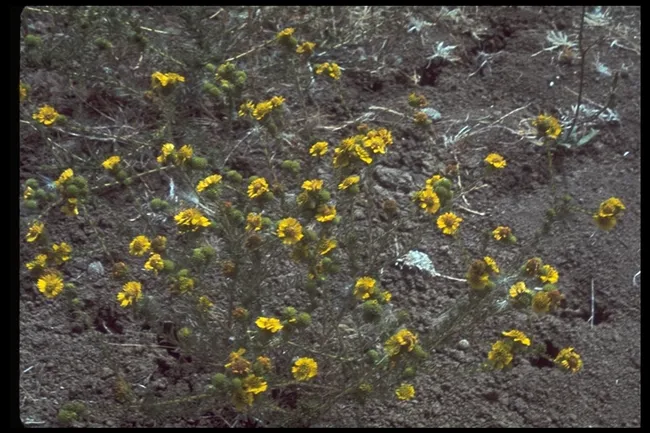
Holocarpha macradenia, commonly known as the Santa Cruz tarplant, is an endangered plant endemic to Northern California. Alternative common names for this plant are Santa Cruz tarweed or Santa Cruz sunflower. The plant's principal range is on certain coastal terraces in Santa Cruz County and Monterey County. Smaller colonies are to the north in Alameda County, Contra Costa County, and Marin County. It is found from sea level to 110 metres (360 ft). Specifically Santa Cruz tarplant likes to inhabit terraced locations of coastal or valley prairie grasslands with underlying sandy clay soils. Its characteristic habitat is in the California coastal prairie ecosystem, which may be the oldest stable ecosystem of the temperate world dating from about 600,000 years ago. Santa Cruz tarplant is an annual wildflower that can grow to 50 cm tall, but is often much smaller. The flowering period is June to November. The growth habit is a single erect stem with larger specimens developing branches. Its leaves are linear and manifest longer near the plant base. The lower ranging leaves exhibit sharp, short teeth at their edges, while the upper leaves present edges that are rolled back, leading to a bristly feeling. Several other species have a similar general appearance, and can be easily mistaken for the Santa Cruz tarplant. The real Santa Cruz tarplant, though, has distinctive glands (see photos) that are not present in lookalikes. Santa Cruz tarplant is an annual wildflower that can grow to 50 cm tall, but is often much smaller. The flowering period is June to November. The growth habit is a single erect stem with larger specimens developing branches. Its leaves are linear and manifest longer near the plant base. The lower ranging leaves exhibit sharp, short teeth at their edges, while the upper leaves present edges that are rolled back, leading to a bristly feeling. Several other species have a similar general appearance, and can be easily mistaken for the Santa Cruz tarplant. The real Santa Cruz tarplant, though, has distinctive glands (see photos) that are not present in lookalikes.
Annual herb
2 ft Tall
-
Likely
-
Confirmed
Yellow-faced Bumble Bee
Bombus vosnesenskii
Lasioglossum tegulariforme
Titus's Sweat Bee
Lasioglossum titusi
Melissodes lupinus