

Carried by 29 nurseries
View Availability at NurseryData provided by the participants of the Consortium of California Herbaria
View additional distribution information on the Jepson eflora
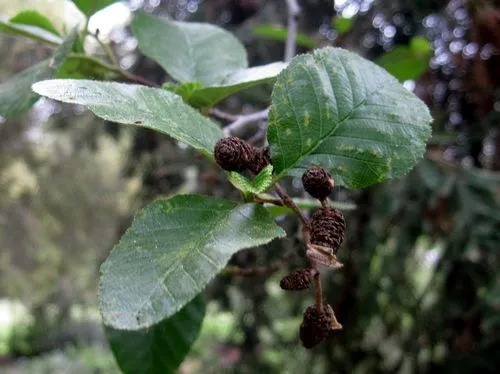
White Alder (Alnus rhombifolia) is a member of the Birch family (Betulaceae) native to western North America, from Washington east to western Montana and south to San Diego County, occurring at altitudes of 300-7900 feet. Though not reported from northern Baja California, it has been predicted to occur there on the basis of its climatic adaptation.
White Alder is a medium-sized deciduous tree. Its pale gray bark is smooth on young trees, becoming scaly on old trees.
The flowers are produced in catkins. The male catkins are pendulous, slender, 1 to 4 inches long, yellowish, and produced in clusters of two to seven. Pollination happens in early spring, before the leaves emerge. The tree produces very large amounts of pollen at this time.
The female catkins are ovoid and mature in autumn, superficially resembling a small conifer cone. The small winged seeds disperse through the winter, leaving the old woody, blackish 'cones' on the tree for up to a year after.
Plant White Alders in moist soils or on the edges of permanently wet areas such as streambanks or edges of regularly irrigated area. These trees grow quickly to 20 feet, and then more slowly. The roots can be invasive, so use caution in deciding where to plant. Due to its ultimate size, White Alder may not be appropriate for small residential gardens.
Tree
49 - 82 ft Tall
35 ft Wide
Upright, Rounded, Upright Columnar
Fast
Winter Deciduous
Pleasant

Green, Cream
Fall, Summer
Full Sun, Partial Shade
High
Keep moist
Fast, Medium, Slow
Tolerant of sand and clay.
Soil PH: 4.0 - 8.0
1*, 2*, 3*, 4, 5, 6, 7*, 8, 9*, 10, 14*, 15*, 16*, 17*, 18*, 19, 22*, 23*, 24*
Usually found in wetland such as permanent stream edges, often adjacent to other vegetation such as chaparral, redwood forest, pine forest, and foothill woodland
Chaparral, Foothill Woodland, Forest, Yellow Pine Forest, Wetland-Riparian
Wetland-riparian trees and plants including Maples (Acer spp.), Dogwood (Cornus spp.), Ash (Fraxinus spp.), Walnut (Juglans spp.), Western Sycamore (Platanus racemosa), Cottonwood (Populus spp.), Willow (Salix spp.), Spicebush (Calycanthus occidentalis), Wild Honeysuckle (Lonicera spp.), Wild Azalea (Rhododendron spp.), Wild Currant (Ribes spp.), Wild Rose (Rosa spp.), and Wild Grape (Vitis spp.).
-
Likely
-
Confirmed
Gray Dagger Moth
Acronicta grisea
Great Purple Hairstreak
Atlides halesus
Obscure Bumble Bee
Bombus caliginosus
Brown-belted Bumble Bee
Bombus griseocollis